
Frustration often hits when you realize your first grader’s writing doesn’t match the expectations of the classroom. You watch them struggle to string together sentences, spell words correctly, or even form coherent ideas on paper. As someone who has navigated this exact struggle, I can tell you the path forward is less about talent and more about understanding the rubric guiding these young writers.
Years ago, I faced a moment of personal failure that reshaped my approach to teaching writing. I had assumed that children would naturally pick up writing skills as they read more books. My daughter came home one day with a graded assignment that was full of red marks. Words were jumbled, sentences lacked structure, and her ideas seemed scattered. I was overwhelmed, unsure how to support her, and frustrated that I had missed the basics. That day taught me the critical importance of knowing the first grade writing rubric inside and out. Without this framework, teaching writing becomes a guessing game, and children are left to flounder in their early literacy journey.
1. Understanding the First Grade Writing Rubric
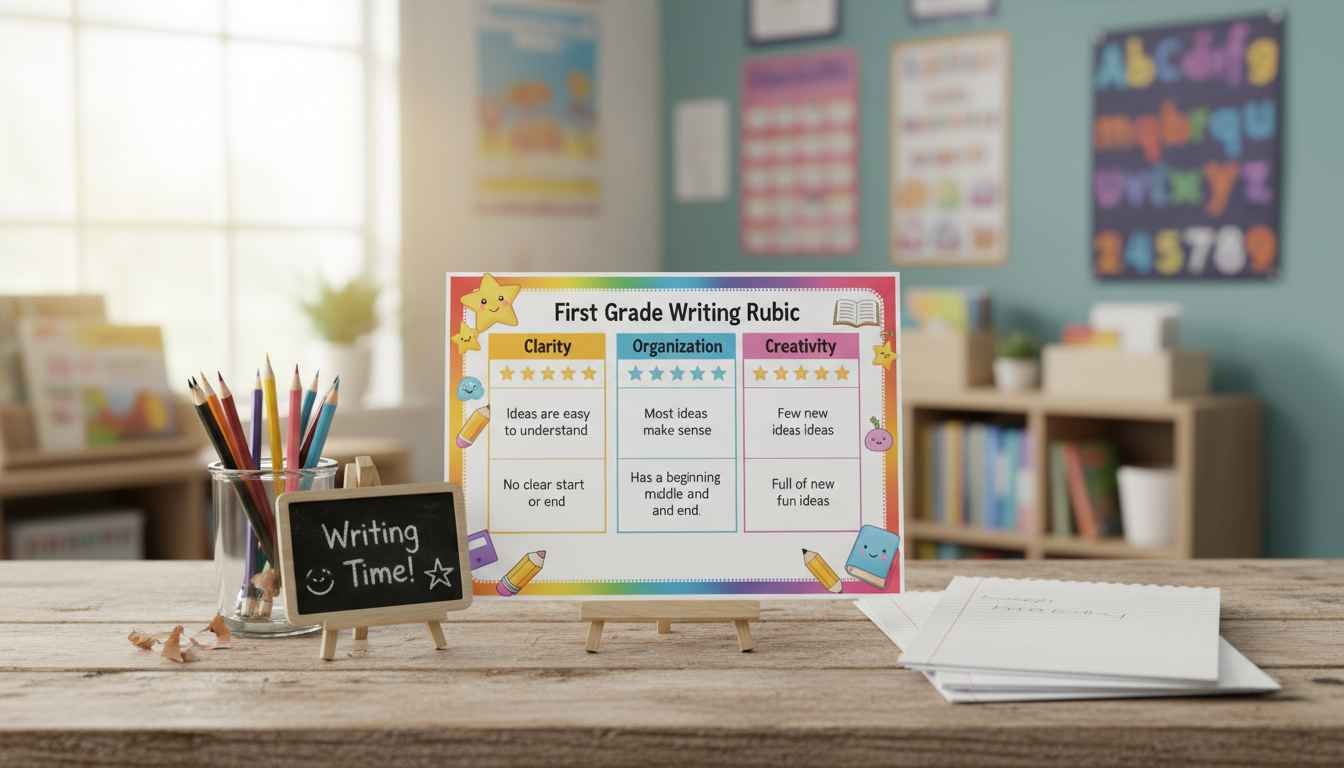
The first grade writing rubric is a structured tool designed to evaluate early writing skills systematically. It often includes several key areas: idea development, organization, sentence structure, spelling and mechanics, and presentation. Each of these categories carries a weight in assessing a child’s writing performance. Understanding how teachers score these areas is vital for parents and educators alike.
For example, idea development measures whether the student can generate and communicate a clear thought. Organization evaluates the logical flow of ideas. Sentence structure looks at the complexity and variety of sentences. Spelling and mechanics assess grammar, punctuation, and spelling accuracy. Presentation considers handwriting, formatting, and overall neatness. Knowing these categories allows you to break down the intimidating task of writing into manageable components.
2. Identifying Common Pitfalls Early
When I first reviewed the rubric, I noticed a pattern: my daughter was strong in creativity but weak in sentence structure and spelling. This is common among first graders who often have rich ideas but lack the mechanics to express them. According to the National Center for Education Statistics, nearly 65% of first graders struggle with writing conventions, highlighting that these difficulties are typical rather than exceptional.
Recognizing these pitfalls early prevents frustration. If a child consistently loses points in spelling, targeted exercises like word families, phonics drills, or sight word practice can make a huge difference. For sentence structure, modeling sentences and encouraging sentence expansion can reinforce correct usage. Each rubric category acts as a roadmap, showing where to focus efforts for maximum impact.
3. Establishing a Daily Writing Routine
Once you understand the rubric, the next step is creating a consistent writing routine. When my daughter and I started dedicating just 15 minutes a day to focused writing practice, I noticed a remarkable improvement. Routine not only builds skill but also reduces anxiety. Children begin to internalize expectations outlined in the rubric without feeling pressured.
Start with guided writing prompts that align with rubric criteria. Ask questions that encourage idea development, like “What happened during recess today?” or “Describe your favorite animal.” Then, guide them through structuring their thoughts into sentences. Over time, gradually reduce the scaffolding to allow independent writing. Tools like HyperWrite can support this process, providing prompts, sentence starters, and examples aligned with first grade standards.
4. Teaching Sentence Structure and Grammar
Sentence structure is often the most overlooked area in early writing. I learned that focusing solely on spelling or handwriting misses the critical component of coherent thought expression. First graders must learn how to form complete sentences with subjects and predicates, proper punctuation, and varying lengths.
Begin by modeling sentences aloud. Break down examples into subject, verb, and object, then have the child reconstruct them. Encourage compound sentences with connecting words like “and,” “but,” and “because.” Introduce punctuation gradually – periods first, then question marks, and exclamation points. Reinforcing these elements ensures children meet rubric expectations while gaining confidence in their writing.
5. Spelling, Phonics, and Mechanics
Spelling and mechanics are concrete areas where progress can be easily measured. I made the mistake of focusing only on creative expression initially, ignoring these fundamentals. The rubric, however, gives significant weight to accuracy. By incorporating phonics lessons, spelling drills, and word games into daily practice, children not only improve their mechanics but also gain independence in self-editing.
Simple strategies include spelling journals, flashcards, and dictation exercises. Rewarding correct usage reinforces learning and makes the process enjoyable. Remember, mechanics are not meant to stifle creativity but to ensure ideas are communicated clearly and effectively.
6. Fostering Organization and Coherence
Organization often differentiates a good assignment from a great one. Early writers may have brilliant ideas but struggle to present them logically. Using graphic organizers or story maps can help children visually plan their writing. I learned that my daughter thrived when she could see the sequence of her ideas mapped out before writing the full text.
Teach them to start with an opening sentence, follow with supporting details, and end with a conclusion. Even at the first grade level, structure matters. Organization is not just about scoring points on the rubric; it sets the foundation for lifelong writing skills, helping children transition smoothly into higher-grade expectations.
7. The Role of Feedback and Revision
Feedback is where growth truly happens. I once gave my daughter a perfect score on her first story just to boost confidence, only to realize later that skipping critical feedback delayed her progress. Constructive feedback tied to rubric criteria is essential. Highlight strengths first, then gently address areas for improvement, providing specific guidance on how to revise.
Encourage multiple drafts. Even short paragraphs benefit from revision. Children learn to self-assess and understand that writing is a process. This approach aligns directly with the rubric, which often considers improvement and effort as part of the evaluation.
8. Leveraging Technology to Support Writing Skills
Technology can be an ally in early writing instruction. AI-powered tools like HyperWrite offer structured prompts, instant feedback, and examples that align with grade-level expectations. I integrated such tools after seeing stagnation in my daughter’s progress. The results were remarkable; she engaged more deeply, practiced independently, and developed a better understanding of rubric expectations.
However, technology should complement, not replace, guided instruction. Human feedback and modeling remain critical. When balanced correctly, tech tools accelerate learning and help children internalize writing conventions faster than traditional methods alone.
9. Who Should Avoid This or Potential Drawbacks
While rubrics provide structure, they may not suit every child. Students with learning differences or English language learners may find rigid scoring stressful. In these cases, a flexible, individualized approach may be more effective. Additionally, excessive focus on the rubric can stifle creativity if children are only taught to write for points rather than expression. Balance is key; use the rubric as a guide, not a strict boundary.
10. Reflecting on Personal Growth and Lessons Learned
Looking back, my initial failure with my daughter’s writing was a turning point. Understanding the first grade writing rubric transformed our approach from frustration to strategic action. We learned to break writing into manageable components, focus on specific skills, and build a supportive routine. Today, she writes with confidence, clarity, and creativity – skills that will serve her well beyond first grade.
For parents and educators, the lesson is clear: mastery of the first grade writing rubric is less about perfection and more about structure, consistency, and guided growth. By focusing on the rubric’s key categories – idea development, organization, sentence structure, spelling and mechanics, and presentation – you equip children to meet early literacy expectations while fostering a lifelong love of writing.
