
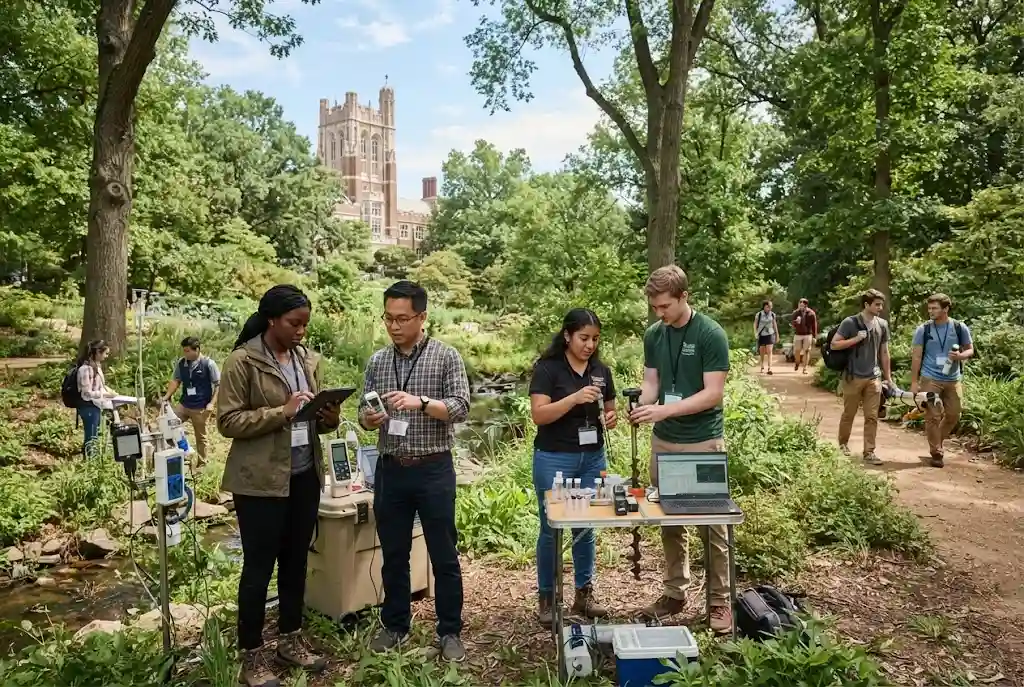
The Center for the Environment WashU is an interdisciplinary hub at Washington University in St. Louis focused on environmental research, education, collaboration, and solutions to complex environmental challenges. The center brings together expertise from different academic fields rather than treating environmental issues as problems belonging to one discipline.
Environmental challenges increasingly overlap with public health, engineering, energy, biodiversity, climate, social policy, economics, and environmental justice. WashU’s approach reflects that interconnected reality by encouraging researchers, students, and partners to work across traditional academic boundaries.
For students exploring environmental education and careers, the center is also part of a broader university ecosystem that includes undergraduate programs, graduate engineering programs, field-based research opportunities, and interdisciplinary initiatives.
What Is the Center for the Environment WashU?
The Center for the Environment WashU is a Washington University initiative created as part of the university’s Here & Next strategic plan. The center serves as a collaborative platform for environmental research and seeks to connect expertise across Washington University and beyond.
WashU describes the center as an interdisciplinary hub designed to mobilize expertise in areas including planetary health, biodiversity, environmental solutions, and environmental justice. Its work is intended to address complex societal challenges that cannot easily be solved within a single academic field.
This interdisciplinary model is important because environmental problems rarely exist in isolation. A question about water quality, for example, can involve chemistry, engineering, public health, policy, economics, and community impacts at the same time.
Why the Center for the Environment WashU Matters
Environmental research has traditionally been distributed across many departments and academic disciplines. While specialized expertise remains essential, complex environmental problems often require those specialists to work together.
The Center for the Environment provides a framework for that collaboration.
Its work connects environmental science with broader questions about human health, sustainability, communities, technology, policy, and environmental justice. That approach can help researchers develop solutions that consider both scientific evidence and the social context in which environmental problems occur.
WashU’s strategic objectives for the center include advancing transdisciplinary environmental research, increasing collaboration among scholars, creating opportunities for graduate students and postdoctoral researchers, and developing resources that can support solutions with local and global impact.
Research at the Center for the Environment WashU
Research is a central part of the center’s mission. Rather than concentrating on one narrow environmental topic, the center supports collaboration across multiple areas of environmental inquiry.
Current WashU materials identify areas including planetary health, biodiversity, environmental solutions, and environmental justice. Research across the university also includes water quality, environmental engineering, air quality, energy systems, sustainability, environmental chemistry, and other related fields.
Environmental Health
Environmental conditions can influence human health in many ways. Air pollution, contaminated water, climate-related hazards, and exposure to environmental contaminants can create challenges that require both scientific and public-health perspectives.
WashU’s environmental programs reflect this connection. Its Environmental Analysis curriculum, for example, includes courses addressing people, the planet, health, environmental health research and practice, environmental justice, and One Health.
Water and Environmental Engineering
Water quality and treatment are important areas of environmental research at Washington University. The university’s Energy, Environmental & Chemical Engineering department includes faculty working in aquatic chemistry, water treatment, environmental biotechnology, wastewater treatment, resource recovery, and related fields.
Daniel E. Giammar, director of the Center for the Environment, is a professor of environmental engineering whose research interests include aquatic chemistry, environmental engineering, water quality, and water treatment.
Energy and Sustainability
Environmental research also intersects with energy systems and sustainable technology. WashU’s engineering programs address challenges involving energy, the environment, chemical engineering, sustainability, and public health.
The university’s graduate engineering offerings include master’s-level study in energy, environmental, and chemical engineering, with opportunities to explore research and professional applications related to environmental challenges.
Environmental Justice
Environmental problems can affect communities differently. The Environmental justice research considers these differences and examines how environmental risks, resources, decision-making, and social conditions interact.
The interdisciplinary structure of WashU’s environmental education allows students to encounter environmental justice alongside science, policy, health, economics, and other perspectives.
Interdisciplinary Environmental Research at WashU
One of the defining characteristics of the Center for the Environment is its interdisciplinary focus.
Environmental questions can require expertise from engineering, biology, public health, social work, policy, business, law, data science, and other areas. WashU’s center was established specifically to encourage collaboration across these boundaries.
The university has described the center as a collaborative effort involving researchers from fields such as engineering, environmental science, public health, and social work.
This model can benefit researchers because it exposes them to different methods and perspectives. It can also benefit students by showing how environmental careers increasingly cross traditional academic categories.
Student Opportunities and Environmental Education
Students interested in environmental issues can engage with WashU’s broader academic ecosystem through undergraduate majors, minors, courses, research, internships, and graduate programs.
The Environmental Science major offered through the Department of Earth, Environmental, and Planetary Sciences is a broad program with coursework covering areas such as ecology, environmental policy, computational modeling, sustainability, environmental impacts of energy use, hydrology, climate systems, remote sensing, and geochemistry.
Students can therefore approach environmental education from different directions depending on their interests.
Environmental Science
Environmental science can provide a foundation in scientific concepts and methods used to understand environmental systems. Students can explore topics related to Earth systems, ecology, chemistry, climate, hydrology, and environmental change.
Environmental Analysis
Environmental Analysis takes a more interdisciplinary approach to environmental problem-solving. WashU describes the major as a flexible program designed to develop interdisciplinary environmental problem-solving skills and allow students to complement another major.
Environmental Studies
The Environmental Studies minor provides another option for students who want environmental exposure alongside a different primary field of study. The university describes the minor as accessible and flexible, with introductory courses and a broad choice of electives.
Environmental Engineering at Washington University
Students with strong interests in science, engineering, technology, and environmental problem-solving can also explore environmental engineering.
Washington University’s Environmental Engineering Science minor requires 21 units and includes environmental chemistry, environmental engineering, environmental policy, social science, and related subjects. The university states that the minor can prepare students for entry-level positions as environmental engineers, scientists, or analysts and provide a foundation for graduate study.
At the graduate level, the Energy, Environmental & Chemical Engineering department offers master’s programs that combine technical education with opportunities to investigate environmental, energy, and chemical engineering challenges.
Tyson Research Center and Field-Based Learning
Environmental education is not limited to classroom or laboratory settings. Washington University’s Tyson Research Center provides opportunities for environmental research and education through field-based work.
WashU describes Tyson Research Center as its environmental field station and notes that it provides opportunities for research and education for students and faculty from WashU and beyond. Its infrastructure supports research, teaching, and collaboration across disciplines and levels of academic training.
Field-based learning can complement classroom study by allowing students and researchers to investigate environmental systems in real-world settings.
How the Center Connects Environment and Public Health
Environmental conditions and human health are closely connected. This is one reason environmental research can be particularly relevant to students interested in health and wellness.
Clean water, air quality, climate conditions, exposure to pollutants, biodiversity, and community environments can all influence health outcomes. Addressing these issues often requires collaboration between environmental scientists, engineers, health professionals, policymakers, and communities.
WashU’s Environmental Analysis curriculum explicitly includes courses such as People, Planet, Health and Research and Practice in Environmental Health, as well as One Health: Linking the Health of Humans, Animals, and the Environment.
This illustrates how environmental education can extend beyond conservation and natural science into broader questions about population and public health.
Career Paths Related to Environmental Studies
Environmental education can lead to a variety of professional directions. The appropriate career depends heavily on the student’s major, technical skills, graduate education, interests, and experience.
Potential areas include:
- Environmental science
- Environmental engineering
- Sustainability
- Environmental consulting
- Water quality and treatment
- Climate research
- Environmental policy
- Public health
- Conservation
- Environmental data analysis
- Energy systems
- Environmental education
- Research and academia
Some roles require advanced degrees or professional credentials, while others may be accessible with undergraduate education and relevant experience. Students should review current requirements for their specific career target rather than assuming that an environmental degree automatically qualifies them for every environmental occupation.
How Students Can Prepare for Environmental Careers
Students interested in environmental careers can strengthen their preparation by combining academic study with practical experience.
Develop Scientific Foundations
Courses in biology, chemistry, Earth science, environmental science, mathematics, and related fields can provide useful foundations for environmental work.
Build Data Skills
Environmental research increasingly relies on data. Geographic information systems, statistics, remote sensing, computational modeling, and data analysis can be valuable depending on the career direction.
Gain Research Experience
Research assistantships, faculty projects, undergraduate fellowships, laboratory work, and field research can help students understand how environmental research is conducted.
WashU’s environmental research ecosystem includes undergraduate research opportunities connected with faculty and environmental programs. Examples of student involvement can be found in research groups participating in Center for the Environment activities.
Explore Community and Policy Dimensions
Environmental problems are not purely technical. Understanding communities, economics, policy, ethics, and public communication can help students approach environmental challenges more comprehensively.
How to Choose a WashU Environmental Program
Students comparing environmental options at Washington University should begin with the type of work they want to perform after graduation.
A student interested in scientific research may prefer Environmental Science. Someone seeking broader interdisciplinary training might consider Environmental Analysis. A student who wants environmental exposure alongside another major may find Environmental Studies useful.
Students interested in technical environmental problem-solving can investigate environmental engineering and related graduate programs.
The university’s current academic catalog should be used to verify course requirements, program structures, prerequisites, and enrollment policies because academic offerings can change.
Environmental Research and Local Impact
One of the goals of interdisciplinary environmental research is to connect academic knowledge with real-world challenges.
WashU’s strategic objectives for the Center for the Environment include providing resources for scalable solutions with greater local and global impact. The center has also established structures for research collaboration, workshops, graduate and postdoctoral engagement, and relationships with external partners.
This local-to-global perspective is useful because environmental challenges often operate at multiple scales. A water-quality problem may begin in a specific community but involve broader scientific, regulatory, infrastructure, or climate-related questions.
Technology and the Future of Environmental Research
Modern environmental research increasingly depends on technology.
Researchers can use computational modeling, remote sensing, geographic information systems, laboratory instrumentation, data analysis, and other digital tools to investigate environmental systems. Artificial intelligence and machine learning may also support certain research workflows when applied appropriately.
Students preparing for environmental careers can therefore benefit from developing digital literacy alongside scientific knowledge.
This interdisciplinary connection also creates opportunities for students who come from technology backgrounds. Someone interested in information technology, data science, or AI can potentially apply those skills to environmental research and sustainability challenges.
Readers exploring broader technology career preparation can also review our guide to getting a job in IT, while those specifically interested in AI can continue with our AI career roadmap.
Common Questions About the Center for the Environment WashU
What is the Center for the Environment at WashU?
It is an interdisciplinary environmental research and collaboration hub at Washington University in St. Louis. It connects expertise across disciplines to address environmental and societal challenges.
Is the Center for the Environment a degree program?
The center itself is a research and collaboration initiative rather than a standalone degree program. Students can pursue related undergraduate and graduate programs across Washington University, including Environmental Science, Environmental Analysis, Environmental Studies, and environmental engineering programs.
Can undergraduate students participate in environmental research?
Yes. WashU’s environmental research ecosystem includes undergraduate research opportunities, and Tyson Research Center also supports environmental research and education for students. Specific opportunities vary by program and faculty.
What environmental subjects can students study at WashU?
Students can encounter subjects including environmental science, ecology, environmental policy, sustainability, climate systems, environmental health, environmental justice, water quality, engineering, energy, and conservation. The exact options depend on the program and current course offerings.
How is environmental research connected to health?
Environmental factors can influence human health, which is why environmental research often intersects with public health and One Health. WashU offers coursework that explicitly connects people, planetary systems, environmental health, and human and animal health.
Final Thoughts
The Center for the Environment WashU represents Washington University’s interdisciplinary approach to environmental research and education. By connecting environmental science with engineering, public health, policy, social sciences, sustainability, and other fields, the center provides a framework for addressing complex challenges from multiple perspectives.
For students, the most important takeaway is that environmental education does not have to follow one fixed path. Washington University offers multiple academic routes, from Environmental Science and Environmental Analysis to Environmental Studies and environmental engineering. Research centers, field opportunities, and interdisciplinary collaborations can add practical depth to that education.
Anyone considering WashU environmental programs should review the university’s current catalog and official program information for the latest requirements and opportunities. As environmental challenges continue to intersect with health, technology, sustainability, and society, interdisciplinary preparation can provide a strong foundation for future study and professional work.
